Best Uses
- Plotting ordered pairs and reading coordinates back off a worksheet
- Graphing linear equations, parabolas, and inequalities across four quadrants
- Transformations: translations, reflections, rotations, and dilations
- Blank-axis quizzes where students label their own scale
- Four small planes per page for homework sets and exit tickets
Print Setup
The default file is generated for LETTER paper in portrait
orientation. Print at actual size when spacing matters.
The linked PDF is a static file, so it can be downloaded, printed, and shared even if custom generation is unavailable.
A real coordinate plane, not a grid with homework
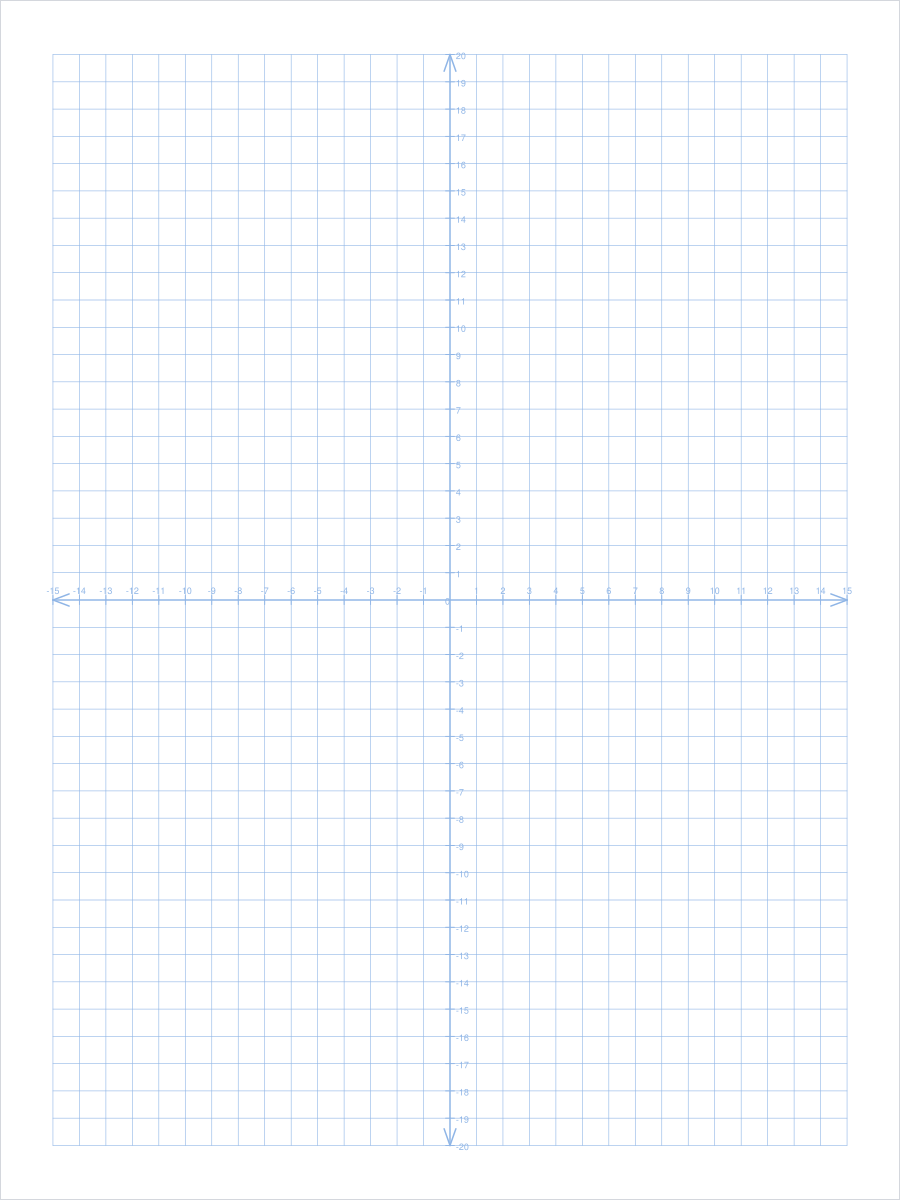
Most printable graph paper stops at the grid: if the assignment needs axes, the student draws two lines with a ruler before any plotting starts, and hand-drawn axes are rarely straight, centered, or square to the page. Every sheet on this page prints the axes as part of the file: a horizontal x-axis and a vertical y-axis crossing at the true center of the plane, with arrowheads on all four ends and the origin sitting exactly where the grid says zero should be.
That changes what the sheet can be used for. Points land in named quadrants, reflections across an axis can be checked by counting squares, and a line through the origin can be read as a slope instead of approximated. The grid is aligned to the axes rather than to the page margins, so the squares count one unit each in every direction the moment the plane is printed.
Numbered or blank axes: which sheet to print
The numbered presets label both axes in grid units, with a single 0 at the origin. This is the version to print for practice: a student plotting (-3, 2) can verify the landing spot against the printed numbers, and a parent checking homework can read coordinates off the sheet without counting squares from the middle.
The blank presets print the same axes and grid with no numbers at all. They are the right choice for assessments, where labeling the scale is part of the exercise, and for anything that outgrows the printed range: label the axis by twos, by tens, or in fractions and the same sheet serves a different lesson. The axes-only preset drops the minor grid too, leaving two clean number lines for sketches, number-line work, or quick whiteboard-style diagrams.
One plane or four per page
The single-plane layout fills the printable area with one large plane: on Letter paper a quarter-inch grid gives 15 units left to right and 20 up, which is enough room to graph a parabola or a system of equations without running out of sheet. It is the default for anything that will be worked on for more than a minute.
The four-per-page layout prints a 2 by 2 grid of complete planes, each with its own axes, arrowheads, and numbering. Homework sets, warm-up drills, and exit tickets need several small graphs, not one poster, and printing four at a time means one sheet covers a whole problem set. Both layouts come in Letter and A4, and both respect the margin you choose.