Best Uses
- Plotting polar equations and unit-circle relationships by hand
- Recording measurements that vary with distance and direction
- Sketching radial patterns, spirals, and rotation diagrams
- Preparing trigonometry homework in degrees or radians
Print Setup
The default file is generated for LETTER paper in portrait
orientation. Print at actual size when spacing matters.
The linked PDF is a static file, so it can be downloaded, printed, and shared even if custom generation is unavailable.
A circular grid for radius and angle
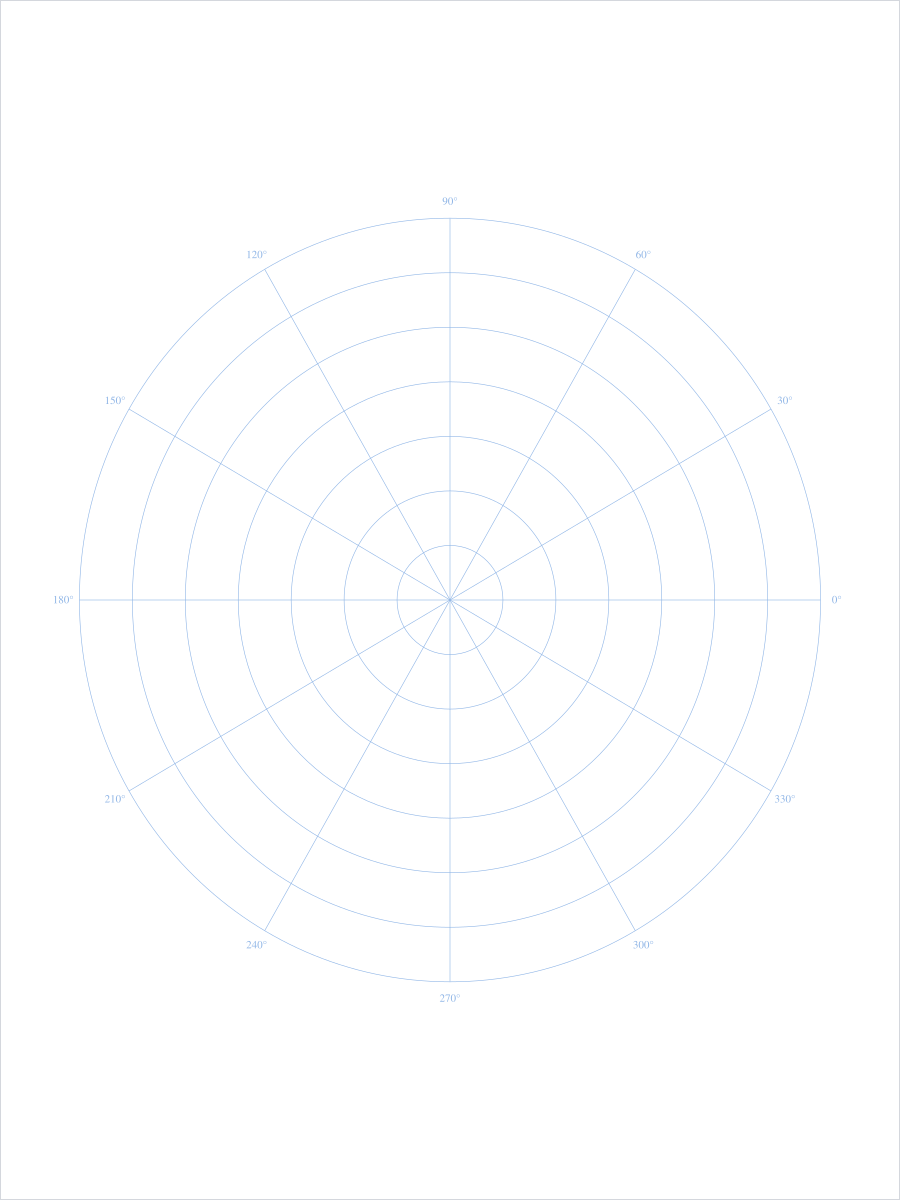
Ordinary graph paper measures left and right on an x-axis and up and down on a y-axis. Polar paper starts at one center point instead: concentric circles measure the radius, while evenly spaced spokes measure the angle. This page generates the actual circular grid in a vector PDF, not a square grid with a polar diagram pasted on top.
The default sheet has twelve spokes, one every 30 degrees, with half-inch spacing between rings. Choose 24 spokes for 15-degree steps or 36 for 10-degree steps. Fine spokes remain visible even when only the major 30-degree positions carry labels, keeping the printout readable.
Degrees, radians, or an unlabeled grid
A degree sheet labels the familiar 0°, 90°, 180°, and 270° directions. The radian preset uses pi notation such as pi/2 and pi, which is useful when a class works with trigonometric functions. An unlabeled preset leaves the angles for students to fill in during practice.
The label choice changes only the notation. Ring and spoke positions are identical for a given division count, so you can compare work made in degrees and radians on the same geometry.
Download and print at true size
The ready-made Letter PDF is linked at the top for one-click download. The controls also offer A4 paper, portrait or landscape orientation, alternate line colors and margins. Rings use physical half-inch spacing by default; choose Actual size or 100% in the print dialog to keep that spacing.
If the problem uses x and y coordinates rather than radius and angle, use the coordinate plane page instead. It has numbered perpendicular axes and a square grid, which are better suited to graphing ordered pairs and linear equations.