Best Uses
- Organic chemistry rings and benzene structures
- Tabletop RPG and wargame hex maps
- Honeycomb charts, mind maps, and infographics
- Quilting, mosaic, and tile pattern layouts
Print Setup
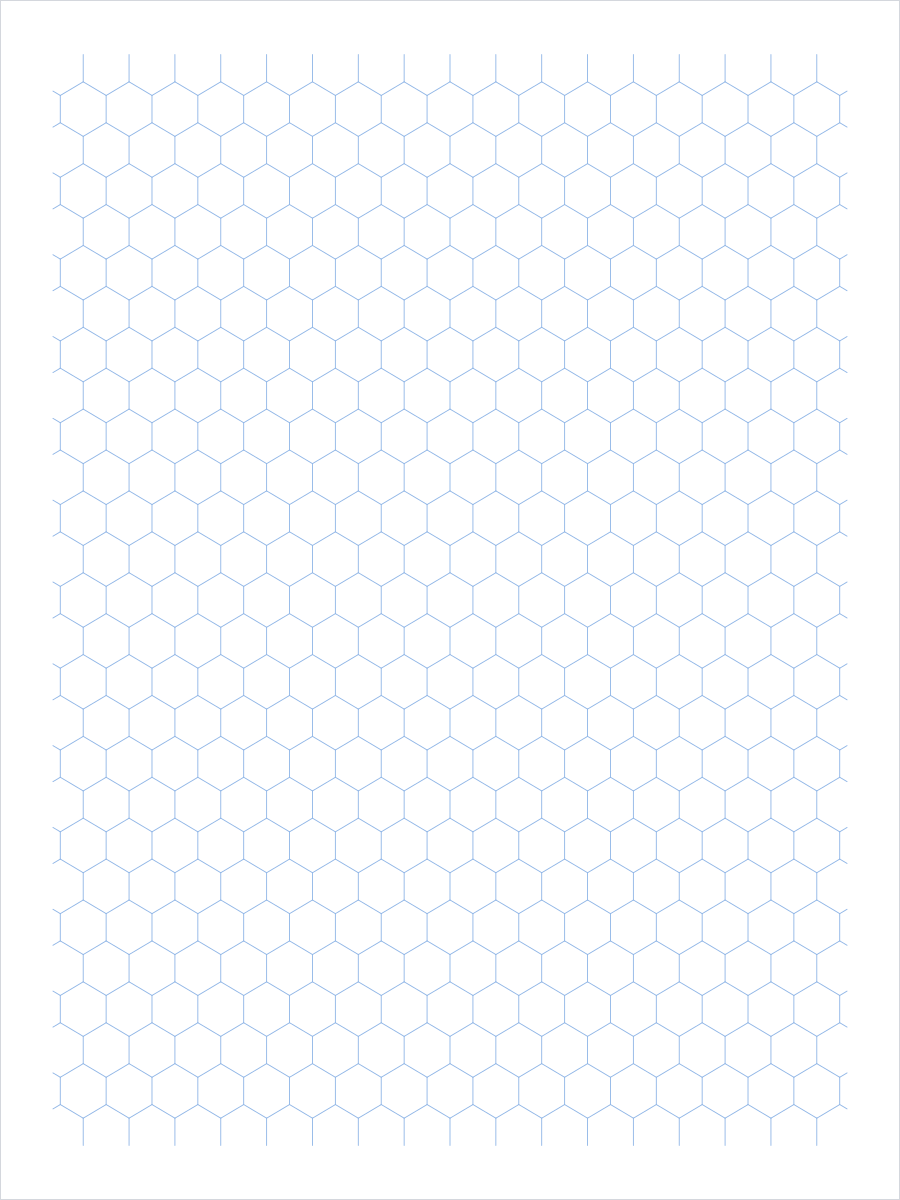
The default file is generated for LETTER paper in portrait
orientation. Print at actual size when spacing matters.
The linked PDF is a static file, so it can be downloaded, printed, and shared even if custom generation is unavailable.
How the hexagonal grid is built
A honeycomb is one shape repeated with no gaps and no overlaps. Every hexagon on this paper is regular, so all six sides are the same length and all six interior angles are 120 degrees. Three hexagons meet at every vertex, and 3 times 120 makes a full 360 degrees, which is why the pattern tiles cleanly.
Because the hexagons are pointy-top, each one is taller than it is wide. Everything on the sheet is set by one number, the side length. The width across the flat sides is the side length times the square root of 3, the height from point to point is exactly twice the side length, and each row of hexagons sits three quarters of that height above the row below it, with alternating rows shifted sideways by half a hexagon.
That last offset is what makes hexagonal paper different to work with. On square paper every cell has four neighbours that share an edge and four more that only touch at a corner. On hexagonal paper every cell has exactly six neighbours and all six share a full edge, so there is no awkward diagonal step. Board games use hexes for that reason: moving one cell costs the same in every direction.
Hexagonal paper vs isometric and square grids
Hexagonal paper and isometric paper are easy to confuse because both are built from 30 degree angles, but they are not the same sheet. Isometric paper is a lattice of small equilateral triangles and is meant for drawing three-dimensional objects on a flat page. Hexagonal paper is a honeycomb of six-sided cells and is meant for filling those cells in, one unit at a time.
The test is what you do with a cell. If you are sketching a cube or a stairwell and want three axes at a consistent scale, use isometric paper. If you are colouring in territory, plotting a map region, or drawing a molecule that sits inside a ring, use hexagonal paper.
Square graph paper stays the better choice whenever the work is measured along two perpendicular axes: plotting a function, drawing a floor plan, or counting stitches in rows and columns. Hexagons have no straight rows in two directions at once, so they are a poor fit for anything that needs a rectangular coordinate system.
Choosing a size and printing it true
Pick the size from whichever measurement matters for your work. Chemists usually think in bond lengths, which is the side of the hexagon. Game and map makers usually think in how wide a cell is across, which is the side length times about 1.73. The conversion table below covers all four sizes this page can generate so you do not have to do the arithmetic.
Print at actual size rather than "fit to page". Scaling a sheet keeps the hexagons regular, since every angle stays at 120 degrees, but it changes the side length by a few percent. That is invisible on the page and still wrong if you are laying miniatures on the grid or measuring a drawing afterwards. Print one sheet, measure across three hexagons, and divide by three before committing to a stack.
Blue lines at the default weight stay visible under pencil while letting written work sit on top, which suits chemistry and map labelling. If the sheet needs to be photocopied or scanned, switch the colour to gray or black first, because light blue often drops out entirely on a copier.
Matching the one-click size to what you are drawing
The four buttons above the controls download a finished PDF the moment you tap them, so there is no need to open the size field just to switch sheets: 5 mm side for organic chemistry rings, 1/4 inch side for general honeycomb work, 10 mm side for honeycomb charts and diagrams, and 1/2 inch side for tabletop and wargame hex maps. Each one matches a row in the conversion table below.
Size matters more here than on a square grid, because a hexagon reads as the wrong scale well before the lines look busy. A 5 mm side keeps a benzene ring close to the size printed in a textbook; the same ring drawn at a 1/2 inch side fills a third of the page, which is the wrong direction for a structure meant to sit inside a line of notes.
At the 1/2 inch tabletop size, the printable area on a Letter sheet is 7.5 by 10 inches inside the default half-inch margins. Divide that by the 0.87 inch across-flats and 0.75 inch row pitch from the table below and one sheet holds about 8 hexagons across and 12 full rows down, call it 90 complete hexes, a little fewer on the rows that are offset because they lose a hexagon at the edge.
Pointy-top in practice: chemistry rings and hex-map orientation
Chemistry gets pointy-top because that is how a ring is drawn by hand: a benzene ring is conventionally sketched with one vertex at the top and one at the bottom, with bonds running down each side. Flat-top would put a bond straight across the top of the ring, which is not how the notation reads.
Tabletop hex maps split between the two orientations depending on the game, and this page only draws pointy-top. A pointy-top sheet becomes a flat-top sheet with a quarter turn of the printed page: a regular hexagon has six-fold symmetry, so rotating it 90 degrees lands on the same 30 degree offset that separates pointy-top from flat-top, since 90 is 30 more than a full 60 degree turn that maps the shape onto itself.
The turn also moves the offset. On the page as printed, alternate rows are shifted sideways by half a hexagon. After a 90 degree turn, that shift runs along alternate columns instead, which is the layout flat-top hex-map rules expect when they describe movement as columns stepping up and down rather than rows stepping left and right.